
Glass frog, (family Centrolenidae), any of a group of tree frogs found in the New World tropics, some species of which have translucent bellies and chests. In glass frogs the viscera are visible, and an observer can see the heart pumping blood into the arteries and food moving through the gut. The frogs’ translucency is a type of camouflage, in which the edge of an animal blends with the relative brightness or darkness of its surroundings. This phenomenon, called edge diffusion, softens the line separating the colour of a frog’s skin from the colour of its background. Not all species have a translucent underside. Viewed from above, most glass frogs appear light green. Their patterning ranges from uniform green to green with white to yellow spots that mimic glass frog eggs. Glass frogs have expanded digit tips that aid in climbing, and this trait allows most to live in trees or shrubs along forest streams.
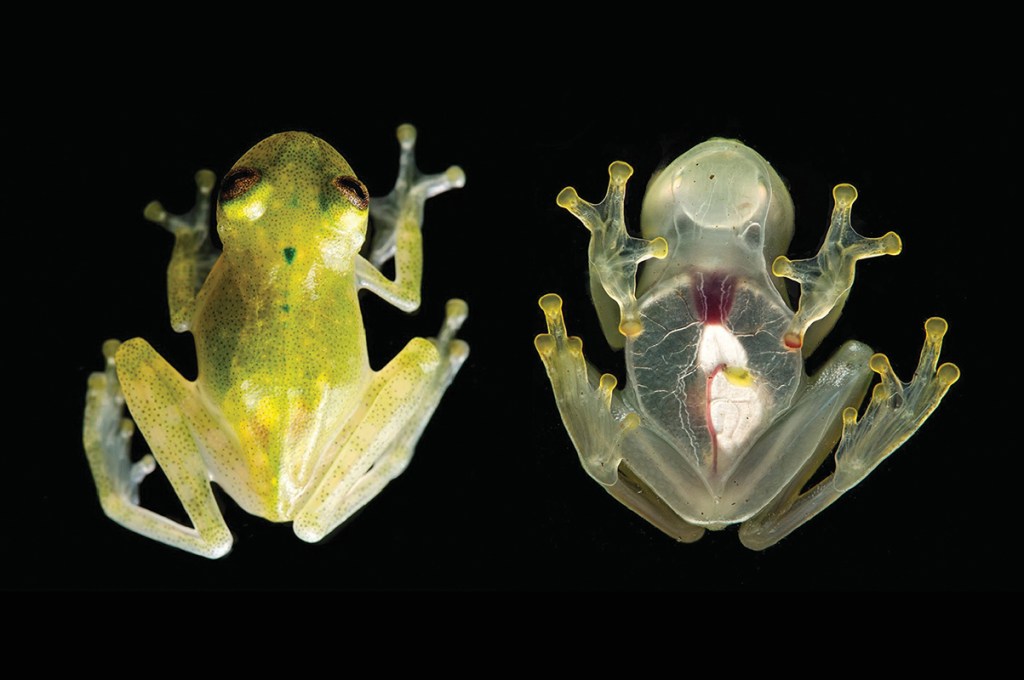
Glass frogs include more than 120 species in about 10 genera (with most species classified in the genera Centrolene, Cochranella, and Hyalinobatrachium). They occur from tropical lowland forests to mid-elevation mountain forests. Most species are small, with adults ranging from 20 to 30 mm (0.8 to1.2 inches) in total length. In a few species adults are larger, attaining a maximum length of nearly 80 mm (3 inches).
For mating to occur, males must first call to females. Calling males sit on leaves—either the top or underside depending upon the species—over streams or lake edges. When a female comes, she does not descend to the water with the amplexing male. Instead, they mate on the calling leaf where she deposits her eggs. After she departs, the male often remains to protect the eggs from predators and call additional females. Some males will attract other females and thus have several egg clutches in various developmental stages to guard. When the tadpoles hatch, they fall into the water below. Tadpoles usually live and feed amidst the leaf litter and stream-side detritus until they metamorphose into froglets. One of the major egg predators are “frog flies,” which lay their eggs on the egg masses. The flies’ eggs hatch quickly, and the maggots feed on the frog embryos.
🐸🐸🐸🐸🐸🐸🐸🐸
 unspoken thoughts
Amazing ✨
LikeLiked by 2 people
https://wp.me/pco6Ex-O
LikeLiked by 1 person